

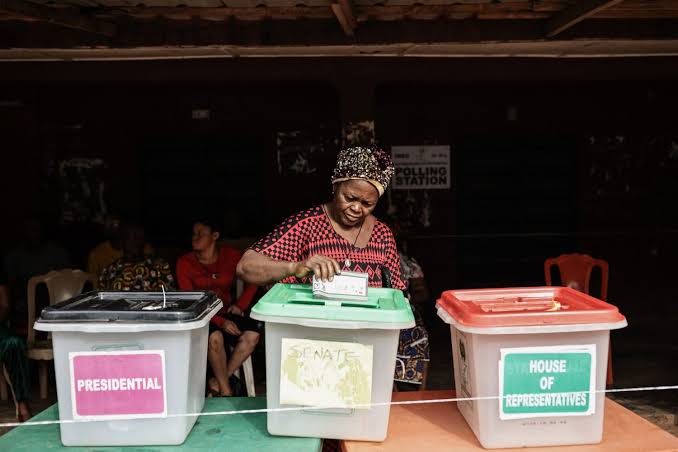
Nigeria’s democracy is facing a troubling contradiction. The judiciary, an institution established to uphold the rule of law, has increasingly become central to determining political outcomes after elections.
Rather than simply resolving genuine electoral disputes, courts are frequently left to determine who ultimately occupies political office.
The issue came into focus at the 2026 Goodluck Jonathan Foundation Democracy Dialogue in Bauchi. Former Presidents Olusegun Obasanjo and Goodluck Jonathan raised concerns about the state of Nigeria’s democracy and the need for institutional reform.
Their concerns are particularly significant as the country approaches the 2027 general elections.
Elections Should Be Decided at the Ballot Box
Ideally, elections should be decided by voters at the ballot box. Courts should intervene only to resolve legitimate disputes and enforce electoral laws.
Jonathan criticised what he described as Nigeria’s unusual culture of post-election litigation and the growing role of the judiciary in determining political outcomes.
He also expressed concern about the extent to which courts have become involved in the internal affairs of political parties. This includes disputes over candidates and party primaries.
Political parties should have the primary responsibility for selecting their candidates. Judicial intervention is necessary where the law has been violated. However, courts should not become another arena for political competition.
Obasanjo similarly questioned the logic of millions of Nigerians voting in an election, only for a five-member judicial panel to determine the eventual winner.
Nigeria’s Winner-Takes-All Politics
Obasanjo’s broader criticism was directed at Nigeria’s winner-takes-all political culture.
A narrow electoral victory can give one candidate almost complete political control while the opposition is treated as an enemy.
That culture weakens democracy.
Nigeria’s electoral history contains several examples of major disputes ending in court. The Supreme Court’s declaration of Hope Uzodimma as governor of Imo State in 2020 remains one of the most controversial instances of judicial intervention in an electoral outcome.
Presidential and governorship elections have also repeatedly ended up before the courts. This reinforces the perception that winning an election is sometimes only the beginning of a longer legal battle.
INEC Must Address Electoral Weaknesses
This is unhealthy for democracy. It can weaken public confidence in elections while placing enormous pressure on the judiciary.
INEC must also accept responsibility for weaknesses in the electoral process.
Technology such as the Permanent Voter Card, the Bimodal Voter Accreditation System and electronic transmission of results was introduced to improve electoral integrity.
However, the controversies surrounding the 2023 elections showed that technology alone cannot fix a political system where actors remain willing to manipulate the process.
Politicians must also take responsibility.
Vote-buying, intimidation, violence and manipulation of electoral institutions continue to undermine democratic participation.
Protecting Judicial Independence
Judicial independence must be protected. But independence cannot become impunity.
Judges who deliberately abuse their positions or violate established legal principles should face appropriate disciplinary consequences.
At the same time, courts must remain capable of cancelling elections where serious violations have occurred.
The solution, however, should be to strengthen the ballot box rather than make the courtroom a permanent extension of the electoral battlefield.
Where an election is fundamentally compromised, the democratic remedy should ordinarily be another election.
Nigeria cannot build a credible democracy when citizens risk their lives to vote, only for the final political verdict to emerge years later from a courtroom.
The ballot box must regain its authority.
Otherwise, democracy becomes an expensive ritual in which Nigerians vote, politicians litigate and judges decide who governs.
