

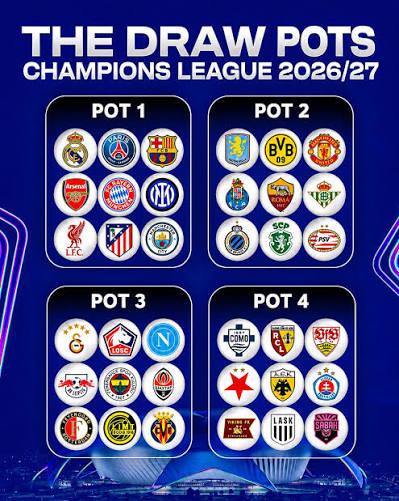
The 2026/27 UEFA Champions League league-phase draw takes place on Thursday, with 36 clubs set to discover their opponents for the new season.
Reigning champions Paris Saint-Germain headline Pot One as Europe’s biggest clubs prepare for another league-phase campaign.
According to UEFA, the draw features nine teams in each of four pots.
Pot One
Paris Saint-Germain, Bayern Munich, Real Madrid, Liverpool, Inter Milan, Manchester City, Arsenal, Barcelona and Atletico Madrid make up Pot One.
PSG enter the draw as holders after winning the Champions League last season.
The other eight clubs complete a formidable group of European heavyweights.
Pot Two
Pot Two also contains several major European clubs.
Borussia Dortmund, Roma, Sporting, Aston Villa, Porto, Manchester United, Club Brugge, Real Betis and PSV Eindhoven are all in the second pot.
English clubs have a strong presence in the draw.
Manchester City, Arsenal and Liverpool are in Pot One, while Aston Villa and Manchester United are in Pot Two.
No English club features in Pots Three or Four.
Pots Three and Four
Pot Three includes Feyenoord, Lille, Bodo/Glimt, Napoli, RB Leipzig, Villarreal, Fenerbahce, Shakhtar Donetsk and Galatasaray.
Slavia Prague, Slovan Bratislava, VfB Stuttgart, AEK Athens, LASK, Como, Lens, Viking Stavanger and Sabah make up Pot Four.
The draw will determine the league-phase fixtures for all 36 clubs.
It will also set the path each team must follow in its bid to reach the knockout stages.
#When Is the Champions League Draw?
UEFA will hold the Champions League league-phase draw on Thursday, August 27.
The event will begin at 6pm CET.
With the 36-team lineup confirmed, attention now turns to the draw.
The clubs will discover the opponents they must face as they begin their campaign for European football’s biggest prize.
CBN Rate Policy Not Designed to Attract Foreign Investors, Says PwC Expert
Nigeria’s monetary policy should not be viewed as a choice between attracting foreign portfolio investors and supporting local businesses, PwC’s Director of Deals Advisory, Wale Olusi, has said.
Olusi said the Central Bank of Nigeria’s priority remained macroeconomic stability rather than attracting foreign portfolio investments.
He spoke while explaining the CBN’s decision to keep interest rates high despite the pressure facing businesses.
“That is the job of the central bank. They target job stabilisation of the macroeconomy, which they have achieved,” Olusi said.
“Initially, people were searching for dollars, but the CBN has stabilised the FX market. It has now reduced inflation,” he added.
High Interest Rates Keep Borrowing Costs Up
The CBN has kept its Monetary Policy Rate at 26.5 per cent since cutting it by 50 basis points in February.
The decision comes as inflation continues to moderate.
However, the tight monetary policy has kept borrowing costs high for businesses.
Manufacturers currently face lending rates of between 25 per cent and 35 per cent.
High domestic interest rates have also made Nigerian fixed-income assets more attractive to foreign portfolio investors.
PwC data showed that foreign portfolio investors accounted for almost all of Nigeria’s $10.37 billion capital inflows in the first quarter of 2026.
Rate Cuts Could Come Later
Olusi said the CBN was not keeping rates high simply to attract foreign investors.
He also said the bank was not focused on cutting rates simply to make borrowing cheaper.
“When the current administration came to power, people were complaining about inflation. What they have done is to reduce inflation and achieve macroeconomic stability,” he said.
Olusi added that the CBN could consider further rate cuts once inflation is sufficiently contained.
“Maybe when the inflation is reduced, CBN can decide to cut rates. But for now, the interest is neither to attract portfolio investments nor cut rates,” he said.
CBN Should Focus on Core Mandate
Emerging markets expert Ike Ibeabuchi said there was no real conflict between monetary stability and attracting investors.
He said investors would naturally enter the market when the CBN maintains price and currency stability.
“The role of the CBN is to maintain price stability, set monetary policy, and manage the naira and FX market to achieve stability,” Ibeabuchi said.
“Once you do all these, investors will come. It is not rocket science.”
He said central bank governors do not normally design monetary policies specifically to attract portfolio investors.
“Maybe that can happen on the fiscal side,” he added.
“But it is difficult for you to target portfolio investors or other types of investors without doing the basic jobs of the central bank.”
